 |
| Rural Turkey, Cappadocia |
I felt the thrill of being a news reporter, without being one. Like a surfer skimming along the lip of a wave, I was walking right in front of a huge mass of chanting protesters along the Istikal Caddesi, one of Istanbul’s busiest streets, towards Taksim Square, with my camera in over drive. My knowledge of spoken Turkish was limited to Teshukor-Thank You, while Arabic script scored at zero, and I did not know what the hell these people were chanting about. The banners did not carry any pictures or signs to help the curious tourist understand what was going on; and I had a feeling that the curious tourist was better off not getting too deep into the issue. In a less than 2 weeks, Taksim Square would be rocked by a suicide bomber linked to the PKK, the Turkish Kurdistan Workers Party, injure dozens, and send shivers down my spine. And yet, at the time I was blissfully oblivious to these political undercurrents, and enjoying the last day of what had been a whirlwind trip to an exotic land that left me craving for more.
 |
| Land of Beautiful Horses |
With an economy growing at close to 6% for the better part of the last decade, and set to cross $1 trillion in 2011, Turkey has been in the media, the news, and my MBA classroom discussions more than once. Even before that, my history textbooks had talked about the Ottoman Turks and Constantinople, murder mysteries had been set on the Orient Express that goes to Istanbul, and I had wistfully looked at Istanbul showcased in glossy inflight magazines umpteen times, as I passed right over Turkey on US-India flights. Now that I think of it, Turkey was right there, at the top of the pile, all the time. And yet, it took a good and highly impulsive friend and his brother to get me to my feet, and finally haul my ass to Turkey with them. The timing could not have been better – right in the middle of my MBA.
My first glimpse of Istanbul was deceptively cursory, just like passing through London, Frankfurt, Brussels and Paris, on one of these US-India flights. Landing in from India, 2 hours at the Ataturk Airport was all I could see of the city, before boarding the onward flight to the town of Kayseri in Cappadocia, Central Turkey. A garrulous American lady who had recently been laid-off, and had decided to make most of it by travelling, made for an interesting neighbour on the flight. ‘You’re Indian but you don’t speak with the Indian accent!’ she gushed, making me cringe. I had involuntarily lapsed into one of my most offensive American accents with her.
 |
Housing
Cappadocian style |
 |
| Göreme National Park |
Cappadocia was a land of corn-flower blue skies, golden grasses, rocky outcrops and caves. It translated to ‘Land of Beautiful Horses’, as I learnt later. While I didn’t see as much as a pony in the next 2 days, the sight of wild horses galloping across the sun-drenched plateaus wouldn’t have been entirely out of place.
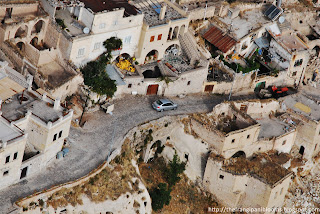
Cappadocia owes its form to Mount Erciyes, a 4000 ft high volcano in the region, the source of soft volcanic rock and ash. Wind and water have done their work over time and carved out strange shapes into the rocks. The natural rock minarets, turrets and fairy chimneys have made for stunning real estate and people have lived in caves in these structures for centuries. The ancient Byzantine churches of Göreme have some of the most elaborate excavated cave structures, their walls lined with fading frescoes, their kitchens still blackened with the smoke.
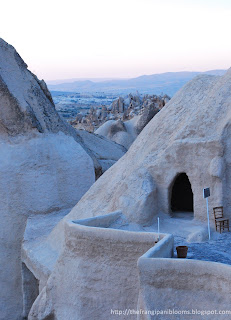 |
Twilight at Göreme
|
Our hotel, Gamirasu, while not a UNESCO world heritage site like Göreme, was equally impressive. It was built in true Cappadocian style, across a cluster of large and small caves on the slopes of a gentle hillside. The lush upholstery, warm lighting, shrubbery in the verandahs, and of course - the wifi connection, quite took away the ‘cave’ness. We were only reminded of it – painfully at times – by the low doorways.
 |
| Evening |
 |
| The Call to the Faithful |
Blessed with abundant sunshine and clear crisp weather, Cappadocian towns retain an almost vintage feel. They have narrow cobblestone streets, low rise houses, and mosques that still dominate as the town’s biggest and tallest structures. The street signs and the conversations are all in Turkish, as if to drive home the point that you are in an exotic land. People hurry home before dark and shops and businesses begin to shut down as the sun dips low. The smell of doners and kebabs wafts down streets at sunset, along with the muezzin’s evening call. Kebabs are to be had in many places in the world at many times, but none of them smell as heavenly as the ones here on the chill evening breeze. They almost seem like an answer to the prayers in the mosque.
 |
| Hot Air Ballooning, Cappadocia |
 |
| Floating in silence |
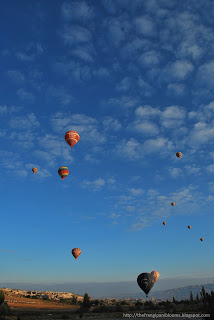
Hot air ballooning over Cappadocia at sunrise the next day was a delight despite of the 4°C chill at dawn. It was an hour of floating over a surreal landscape of hewn rock-columns, towers, obelisks and needles, and quaint villages where, seemingly, life had never bothered to change over centuries. It took a solitary car here and there to remind one of the present. And nothing came close to the vast silence that surrounded us in all three dimensions, as we floated over the sun-warmed lands pretty as a picture.
 |
| Cave-Houses |
Our tour operator in Cappadocia apparently had a lot of his clients coming in from India, and even travelled to India on business every other year. His 20-something secretary, who had welcomed us with sparkling green eyes and warm apple tea, was as gorgeous a Turkish beauty as you could find. Despite her extremely limited English, on our last day in Cappadocia she had made small talk, enquired about our backgrounds, and asked how early did we marry in India. Unfortunately the conversation was short lived as her boss barged in with something completely unrelated to matrimony. He did let slip at the end that the her father was a conservative man and a local Police Chief, with a certain smugness that said we weren’t the first to make small talk. And so from the dry central highlands we headed to the Mediterranean shores to see the ruins of ancient Greek cities, natural springs, and a beautiful port town.
 |
| Uçhisar Castle from the air |
 |
| Uçhisar Castle and the Valley of Pigeons, Cappadocia |
The coast-hugging road that we drove down from Izmir airport to the ancient Greek city of Ephesus from must have starred in many an ad. The Aegean Sea was almost a painful blue. It was rather ironic that original Mediterranean landscape reminded me of California. Greco-Roman ruins in Turkey was also quite unexpected, until I realised that Turkey was only born in 1923 from the remains of the Empire of the Ottoman Turks, who themselves came to Turkey from Central Asia not before 1000 AD. 1600 years earlier, during the golden period of Ephesus, this land was Anatolia, inhabited by the Greeks,
and later, the Romans and the Byzantines.
 |
| The Temple of Hadrian, Ephesus |
 |
| Marble ruins of Ephesus |
Ephesus was a vast city for its times, with more than 250,000 people living here at its peak. Second only to Rome, it was, not surprisingly, the second largest city in the world. It survived many attacks and changes of power, but its real undoing proved to be the gradual silting up of the Cayster River, which blocked its access to the Aegean Sea, rendering its harbour useless.
 |
| The Library of Celsus, Ephesus |
Today its white marble ruins stand out under a blazing blue sky. Even in its broken state, the clear straight lines, the concentric circles and the angular edges are unmistakable. As is the evidence of painstaking planning to ensure that it had everything that a city would ever need, from parliaments to marketplaces, libraries to theatres, and public toilets to brothels. The still standing façade of the magnificent Library of Celsus and the colossal open air theater that could seat more than 40,000 spectators give some idea of the city that once was. It is cruel irony that the single standing tower of the Temple of Artemis, one of the Seven Wonders of the Ancient World, is a grim reminder of the destructive power rather than the glory of religion. The Pagan temple dedicated to the goddess Artemis survived natural disasters, looting and arson. But the final blow was dealt by early Christianity, declaring Paganism as Devil-worship.
 |
| Kuşadasi Waterfront |
 |
| Mary's house |
Jesus’ mother, Mary, is said to have spent her last days in the hills around Ephesus, and the house that currently exists has been built over ruins that date back to the relevant period. Whether Mary lived her last days here or in Jerusalem is still apparently a matter of debate. As is the historical accuracy of the story of Christianity. But the idea that an old lady, whose son had been murdered for his non-compliant religious beliefs, spent her last days in these secluded hills with the help of her son’s friends is entirely possible, and I could live with that.
When you’ve been trudging around hillsides under a cloudless sky for a whole day, and your feet have turned to quivering jelly, it’s surprising what a warm shower can do. This was exactly what was on my mind during our post-hotel-check-in-and-shower stroll along the beach that evening at the beautiful port town of Kuşadasi. Mediterranean cruise liners coming in from Greece dock at Kuşadasi, and we saw a couple of them pulling into the harbour as we walked. A gold and orange glow of the sunset lingered in the sky. The promenade along the waterfront was aglow with shops, restaurants and bars welcoming the guests from the ships. As the Dominos, McDonalds and Heinekens flashed their signs, Ephesus, Artemis and Mary went back to where they belonged in time - far far away.
 |
| The ruins of Hierapolis |
 |
| The road to Hierapolis |
The next day, at the natural calcium deposits and terraces at Pamukkale, was different day altogether. Cold, cloudy and windy, there was a smell of rain in the air as we climbed the steep hillside to the ancient Roman ruins of Hierapolis, a city that started out as a spa and healing centre, associated with the natural springs of this area. Ephesus, Hierapolis and Bollywood were part of the the reason for our trip to Turkey.
Bollywood lives on a staple diet of love stories, and constantly needs new romantic locations for the lead pair to sing its love to each other. This can end up inspiring people like my friend who got me to Turkey. When he saw super-star pair Katrina and Ranbir cavort around the ruins of Pamukkale, Hierapolis and Ephesus in this song (
Tu Jaane Na ), he decided it was time to pay a visit.
 |
| Calcium terraces, Pamukkale |
Unlike the song, we could not see Pamukkale’s glory sans the visiting tourist hordes, but the white calcium cliffs and terraces were very impressive nevertheless.
Turkey had quite surprised me so far with what it had to offer. Just as India is the land of Tigers, Elephants, and Snake Charmers, Turkey to me had been the land of Hookahs, Kebabs and Belly Dancers. Though both definitions do capture the salient points, both are just as incomplete. It was time to see some more of Turkey, Istanbul was calling, and soon we were flying off into the night to Ataturk Airport.
 |
| A cold blustery day in Istanbul |
 |
| The Bosphorus |
Straddling the continents of Asia and Europe on either side of the Bosphorus, Istanbul is certainly a remarkable city. It sits on a narrow strip of land that separates the Sea of Marmara to the south from the Black Sea to the north. The 31 km long Bosphorus Strait is the only channel of water that cuts across this strip of land, connecting the two seas. Its little surprise that the city grew to such importance – its ruler not only controlled the land link from Europe into Asia, but also sea-borne trade between Russia and the Mediterranean. Anyone who ruled here was only too aware of this - from the Byzantine Emperor Constantine after whom the city was named Constantinople, to Ottoman Sultans who infused the city with Islamic architecture, cuisine and culture.
 |
| The Queen Mother Mosque, Istanbul |
 |
| The Blue Mosque |
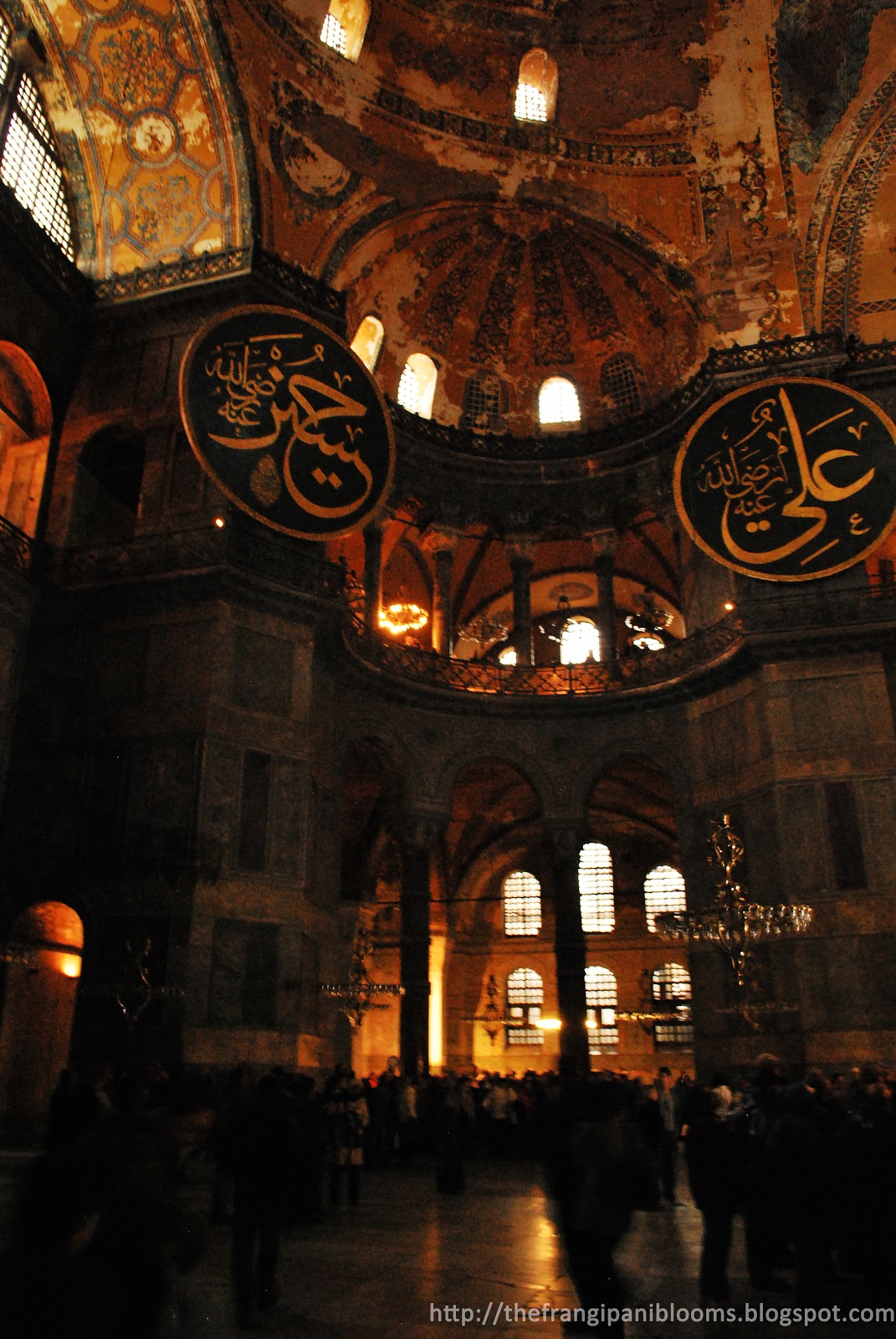
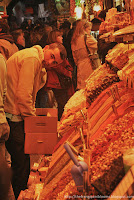
As we set out on a city tour, the weather that was closing in at Pamukkale finally broke. Cold and blustery, the weather whipped the Bosphorus into frenzy, and the glistening wet cobblestone streets were filled with people huddled in coats and under umbrellas. Cafes pulled away their outdoor seating on the sidewalks, and gone were any hopes of a sunset walk along the Bosphorus. Nevertheless, the city lived up to its name as the melting pot of history and cultures. The Blue Mosque, and the Hagia Sophia – a church, a mosque, and finally now a museum – are huge imposing structures, architectural marvels, and concentrated concoctions of history. Equally intriguing is the Grand Bazaar, and the Egyptian Spice Market, both of which continue to be in use today. The indoor streets of these covered bazaars are a kaleidoscope of colours, sights, sounds, smells and faces. Within the few minutes I stood there, a cross section of Istanbul’s population passed me by.
 |
| Hagia Sophia |
 |
| Egyptian Spice Market |
The royalty of Istanbul, however, lived in the magnificent Topkapi Palace. The gates of this palace of the Ottoman Sultans look like they have come straight from the movie Shrek. The vast treasures inside look more like they have been pulled out of the Arabian Nights. Ottoman Sultans wrested Constantinople from the Byzantine Emperors, and ruled Turkey in a reign of unmatched power and wealth until very recent times. As a result, many relics of the Ottoman era, including the Topkapi Palace, have been preserved remarkably well, and give a very real glimpse into the empire.
We were late to get out of Topkapi, and missed our tour bus. The ensuing walk back to the hotel through the wind and the drizzle and the wet streets of Istanbul was an up-close and personal encounter with Turkish street food. The Galata Bridge over the Bosphorus had carts of pretzels, peanuts and sausages. The Istikal Caddesi (Istikal Street) on the other side was lined with shops selling kebabs, pizzas and doners. Doners are stacks of boneless marinated meat packed close like a sausage, skewered on a slow rotating vertical rod and placed close to a burner. The stack is topped with fat that drips down the stack as it is heated. The spiced meat roasts slowly in the fat and its own juices. When sliced off onto pita bread with white sauce, it makes a snack that you have to be really unfortunate to miss.
 |
| Turkish Dolma and Pasta |
But thinking back to all the lunches and dinners we had had, starting from the ‘dining cave’ at Gamirasu hotel, I realised that Turkey, in fact, is a very friendly place for vegetarians. My two vegetarian friends who watched me devour fish and meat at almost every meal, would certainly attest to that - because they themselves had their plates full of assorted selections at all times. Yogurt, cheese, spices, vegetables and saffron are extensively used in Turkish cuisine. Some specialities like Dolma (vine leaves stuffed with cheese and glazed with olive oil), Humus, and Pilav (spiced rice with meat/veggies - akin to the Indian Pulao) are positively mouth-watering. Nothing beats Turkish desserts though, and the Baklava takes top honours here. It’s actually worth trying to find the closest Turkish restaurant for Baklava, if someone hasn’t tried it before. Liberal use of sugar syrup, nuts and cream ensures that Turkish deserts do their bit for your taste-buds and coronary arteries.
 |
| Turkish Carpets |
 |
| Ortaköy Mosque, Istanbul |
 |
| Tramway, Istanbul |
A couple of days earlier, on our way to Istanbul from Pamukkale, we had stopped at a roadside eatery. As we awaited our brick-oven pizza, I had a few minutes to reflect about this exotic land. Behind the layers of exotic mystery that it hold for tourists, Turkey has had its own share of problems: Kurdish rebellion, long-standing issues with Armenia over the Armenian Genocide, the challenge posed by the surging Islamic orthodoxy, rapid growth in a globalized world and the economic inequality left in its wake – our blonde haired guide to Pamukkale and Hierapolis talked long and deep about these issues. He had some German blood in him – blondes are very uncommon in Turkey. He was most worried about radical Islam turning back Turkey’s progress a few decades. He talked about the radicalists' efforts to undermine the independence of the judiciary, and islamicize the educational system. To me, the fact that he was talking about these issues to a bus full of tourists, was in itself a testimony to the success the Turkish Government's liberal policies thus far.
 |
| Interior of a mosque, Istanbul |
 |
| Istikal Caddesi, Istanbul |
Now on the last day, as I watched the protesters march into Taksim Square, I could not help wondering what this protest was about, and whether it would even be possible to have such demonstrations in Turkey in the future. The uncertain future notwithstanding, the allure of the country was unmistakable, and a week of freedom from the MBA was priceless. My friends, unencumbered by any such burdens, were flying off to Greece the next day, as I would be making my way back to business school.
I smiled as I remembered my short definition of Turkey again. I had smoked the Hookah, had a bath in a Hammam, stuffed myself with local cuisine and kebabs, hemmed and hawed over priceless Turkish carpets without buying any, and even tried the national drink-Raki, aniseed flavoured and very potent grape liquor. In the land of Kebabs, Hookahs and Belly Dancers, I had, however, missed out on the third piece. May be Turkish belly dancers are a good reason to visit again.