Showing posts with label food. Show all posts

Saturday, 15 December 2012

Parlez Vous Anglais?


A city unlike any other
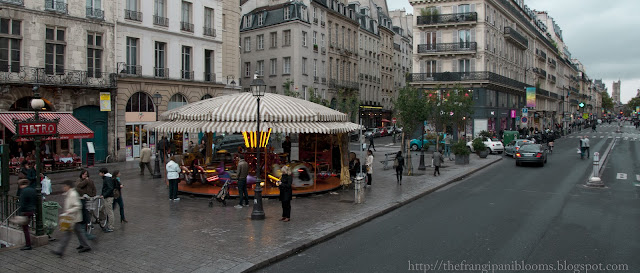

Carousel Carnival
I think fluorescent tube-lights cast a very unflattering white light. Add to that a clattering metro train with an ageing steel chassis, worn purple seats and damp grey platforms outside the grimy windows and you definitely don’t have the most cheerful of atmospheres. The crowd is a mix of black and white people, with a stray brown bloke like me thrown in. This could easily be New York’s gloomy subway. It’s even got the same garish fluorescent graffiti on platform walls and tunnels.

Wrought Iron
Arguably the most famous iron structure in the world
But then you start to notice things that make you rethink the city you are passing under. The station name that reads Bréguet-Sabin announced is ‘Bghreegay Sabaan’. You take a closer look at the blacks, whites and browns in the train and notice that all of them (except yours truly) are unusually well-dressed for a regular rush-hour commute in October.Understated shades of grey, burgundy, brown and black are everywhere. No frumpy shoes, sweat-shirts, pink and red coats, or synthetic wind-cheaters here-everyone is complete with a warm woolen coat and a subtle scarf. The younger lot (which is almost everyone in the carriage) sport slim fit jeans and t-shirts. (And they all are ‘slim-fit’ sized-no bulging biceps and buxom beauties here) The much-talked about man-bag makes an appearance along with the designer purses. Many have their noses buried deep in thick paperbacks rather than a game of Angry Birds on i-Phones. As the train slows, you notice the posters on the platform walls with their faded, old but tasteful tile-work. A huge print of a classic Raphael oil on the walls declares “’Raphael in Rome’ opens at the Louvre”. The adjoining one urges you to watch for the annual event of Salon du Chocolat starting from 31st Oct. An announcement booms through the underground station in that language which is always music to the ears, even if you don’t understand it. A Bonne Journée stall near the exit selling the last of its croissants off the now empty shelves completes the picture.

I was riding in to Paris on the metro from the Charles De Gaulle Airport to my brother’s apartment. Over the next nine days, I would get up close and personal with the arts, architecture, language, people and food of this city and repeatedly confirm what I had realized on that first day- Paris is like no other city in the world. And that is so because Parisians want it to be so.

Paris Champs Elysses
Arc de Triomphe
For one, Paris, (like the rest of France and Europe) is a place that reminds you of the origins of English from a small group of islands off the Channel Coast. That it became the ubiquitous global super-language we know now was a game of chance, the French would have you believe. It’s little surprise that the title of this blog-post is the question I started most of my conversations from Oct 10 to Oct 19 with. The answer varied from ‘Yes I do’ to ‘Un peu (a little)’ in Paris; but in the sea-side town of Granville on the coast of Normandy I also got a flat ‘Non’ with the classic French shoulder-shrug from a waiter. (This resulted in considerable agony since the menu of the only open restaurant within a 2 mile radius was French. When - out of sheer dare-devilry - I ordered the first item in the menu, they turned out to be bulots - sea-snails. I am only glad they didn't taste half as bad as they looked).  This disregard for English is a strange feeling for someone from a country that no longer thinks of English as a foreign language. The French, however, have resolutely stuck it out so far, and still relegate a lowly second place to Anglais on their sign-boards – if at all that is.(Also, the English font is at least 5 sizes smaller). Parisians, however, are conceding some ground-most Parisian signboards do have both languages.

Evening Paris
Evening settles over Paris, seen from the Montparnasse
For another, much of Paris it looks like it just stepped out of 1892 into 2012. The World Wars that flattened so many cities in Europe, especially in Germany, spared Paris. The city rarely rises above 4 storeys. And those 

are 4 storeys of ornate stone facades with the top windows jutting out of sloping roofs, while the bottom levels are occupied by beautiful cafes and shops. Even a simple pharmacie in Paris can have art deco lettering and a 1920’s shop-front. Parisians have stubbornly refused to allow any new construction within the confines of their old city. The top of the new Montparnasse tower built in the early 70s is snidely called the best spot in Paris, because it is the only place in the city from where you cannot see the skyscraper. This heritage tag attached to every brick and paving stone has strangled the supply of new homes within the city limits. As a result, many Parisians just end up renting a house and never buying one all their lives. Even the portable green ‘box’ book shops on the banks of the Seine (‘the only river that runs between two bookshelves’) are coveted property.  A tradition harking back to the 16th century, new licenses for these bookshops are no longer being issued and existing ones are handed down like family heirlooms. 

Sunshine Rain
The sun after the rain
Finally, through the long years of the 18th and the 19thcenturies, Paris has been the crucible for experiments in urban living, pursuit of the arts and philosophy, free thinking and sophistication. The process may have been catalyzed by the many revolutions that France went through, the French Revolution of 1792 being the most famous. But it has also been a process of maturing as much as it has been about upheaval and churning. Paris has been home to some of the West’s most famous intellectuals, iconoclasts, artists and rebels through the golden years of its history. These people have contributed to the texture and flavor of the culture that Paris has so prided herself on. 

Paris Streetscape
A Parisian street leading to The Luxembourg Gardens
Hemingway, Fitzgerald, Voltaire, Sartre, Orwell, Picasso, Monet, Renoir, Van Gogh and the other names that I heard on my various excursions in the city, lived and worked here, created some of their most famous works here, and quite literally, rubbed shoulders with each other. And I don’t just mean at the salons1 or the Salon de Paris2. I mean rubbing shoulders in everyday life, in the parks, on the streets, and in the cafés.  A walk down through the neighborhoods of St. Germain and Montparnasse can take you past a Café de Flores, where Sartre and Simone de Beauvoir spent a lot of their time, or a La Rotonde or a Le Dome, which regularly hosted Hemingway, Fitzgerald and Eliot, and even found a mention in their novels. Go  further down from St. Germain and you can see the famous Luxembourg Gardens, Victor Hugo’s choice of setting to get lovers to meet in Les Misérables, and a favorite rendezvous spot for Hemingway and his contemporaries like Ezra Pound and Gertrude Stein. 

Napoleon Dome
Les Invalides after a squall of rain
Autumn in Paris is unpredictable weather, and cold drizzling rain can last for whole days. But when the sun does come out it can be worth the wait. We got on to an open-top double-decker hop-on-hop-off bus, Le Open Tours, on one such sunny day and were treated to a city basking in glorious sunshine. The buses were, for a change, filled with people as inept at French as us, and I bet that common handicap gave everyone a bit of unknowing comfort. 


Paris Napoleon
The gardens of Les Invalides 


Of course we hopped off at every major monument for a closer look. But we also saw much of the city from the upper deck, as we rode past leafy boulevards littered with autumn leaves and windows with roses blooming on the sills, past chiropracteurs and boulangeries, and marchés and bureax de poste, and fleuristes and brasseries, across narrow cobblestone streets and wide bridges over the Seine. The city is an incredible portrait of the 18th century urban aesthetics of Europe. 

“Parisians seem to spend an inordinate amount of time on appearances”, my brother had quipped when I had first asked him about his impressions of the city. Well, the city does it too, and in grand period style.

Autumn Paris
A bright autumn day in Paris


_________________________________________________________________________________
1. Salons: 17th and 18th century literary gatherings to exchange and appreciate each others’ work
2. Salon de Paris: The official annual/biannual art exhibition of the Académie des Beaux-Arts, arguably the West’s greatest art event in the 18th & 19th centuries to which many a Monet owes his fame


Of Dinners and Museums

Fine dining  is a concept that Paris has given to the world, among other things. Even as a kid, I remember my characters in Enid Blytons and PG Wodehouses drool over French cuisine. Wodehouse’s celebrated French chef, anatole, has always been a key bargaining chip in negotiations to extricate Bertie Wooster from the soup he usually finds himself in. 

Coffee Conversations
Coffees and Conversations from the city that gave the world the Café

Montmartre
The Sacré-Cœur Basilica at Montmartre
Dining out is serious business in Paris and has been so for far longer than any other place in the world. You could choose to eat in a Café, a Bistro, a Brasserie, or a Crêperie3. The food is delectable and expensive-a meal in Paris with wine can cost anywhere upwards of 20 Euros per person. The confit de canard (duck), the chèvre (goat cheese) pastas, the moules-frites (mussels and fries), the Crème brûlées and the vins (wines) that I had at various times on this trip were absolutely delightful, my preference for vegetarian food notwithstanding. But dining in Paris is as much about the company as it is about food. You catch up with old friends and even meet new ones over long leisurely dinners. One dinner I had lasted for 2.5 hours. No plates were cleared until the last person on the table had finished eating and no check was produced until we asked.

Paris Dusk
Paris lights up at dusk
The notorious French working culture was inevitably the topic of conversation that night. ‘Is it really like that?’ we asked our French friend we met over dinner that night, after discussing a few horror stories about how the French (don’t) work. He smiled. “It’s always a bit exaggerated. A 60 hour work week for people like us is not uncommon at all. Nowadays it might only be the lower ranking staff like bank tellers who can pack up and leave at 5 everyday. Anyone who holds a position of responsibility and has the ambition to build a career had better think twice about how he works”. A highly educated fresh graduate, perhaps he represented a changing face of the French workforce (one that spoke English very well). And he never spoke a truer word. With two rating agencies stripping France of its AAA rating and a not-so-veiled threat to do likewise from the third4, the France is going to have to pull together its game, and soon. One misstep and it may find itself on the path to join its Mediterranean neighbors in the south.  But change is slow. Some things will be hard to let go of, and I can very well imagine why.  A passing mention of his 50 ruddy days of vacation a year was enough to leave us green with envy.

Paris Evening
The glittering city seen from Montmartre
“I feel so nice when someone makes the effort to learn and speak French. We’re rather proud of our language, and appreciate it when someone takes notice of it”, he said, steering the conversation to calmer waters and echoing the sentiments of many other French men and women I met through the trip. A little ‘Bon Jour’ and ‘Excusé Moi’ and ‘Merci’ can change the tone of a conversation.  French is indeed a very beautiful language. Other merits of a language apart, it sounds incredibly musical to the ears, far more so than English or any other language I know. You only have to hear a French song like La Vie En Rose to realize that the language was built for music, with its nasal ‘ain’s, the curvy ‘oi’s, the sensual ‘j’s ‘ and the very French ‘u’s (made by pronouncing an ‘ee’ but puckering your lips as if to kiss). Even the soft throaty ‘r’s manage to join in the harmony. German on the other hand sounds like chain saws, and many Indian languages, like rattling trains.

Louvre
The Mona Lisa holds court at the Louvre
Louvre
A medieval German bust of Christ 
That very satisfying dinner had come on the heels of a very rainy afternoon well-spent at the Louvre. I doubt if any other museum in the world is so famous, and has so many visitors who couldn't care less about history and art. I know people who would prefer water-boarding at Guantanamo to visiting museums. And yet they all have visited the Louvre. Their recollections of  the place usually consist of statistics like the 10 miles they walked inside the museum in a single day, and the 20 minutes within which they managed to ‘cover the whole of Renaissance and Ancient Egypt’. Well, I decided to spend 20 minutes at the entrance with a map instead, and  concluded that I only wanted to see the Dutch and Italian paintings, the Marble Sculptures and Napoleon III’s apartment. And to start with, I made a beeline for the Mona Lisa. 
Louvre
The Marble Warrior
Louvre
At the end of the day, I walked very few miles at the Louvre, but had more than enough time to marvel at the lush works of art that stood arrayed before me.  These masters have shown that heroism, pathos, love, pain, all can be carved out of stone and frozen on to a canvas. It must have taken a detailed study of human anatomy, years of practicing their workmanship, and finally, a heart to feel everything that you wanted your viewer to feel. The Dutch landscapes, for instance, have the power to stop you in your tracks.  They take you straight to the hills and rivers and woods of the European countryside, under the open skies.
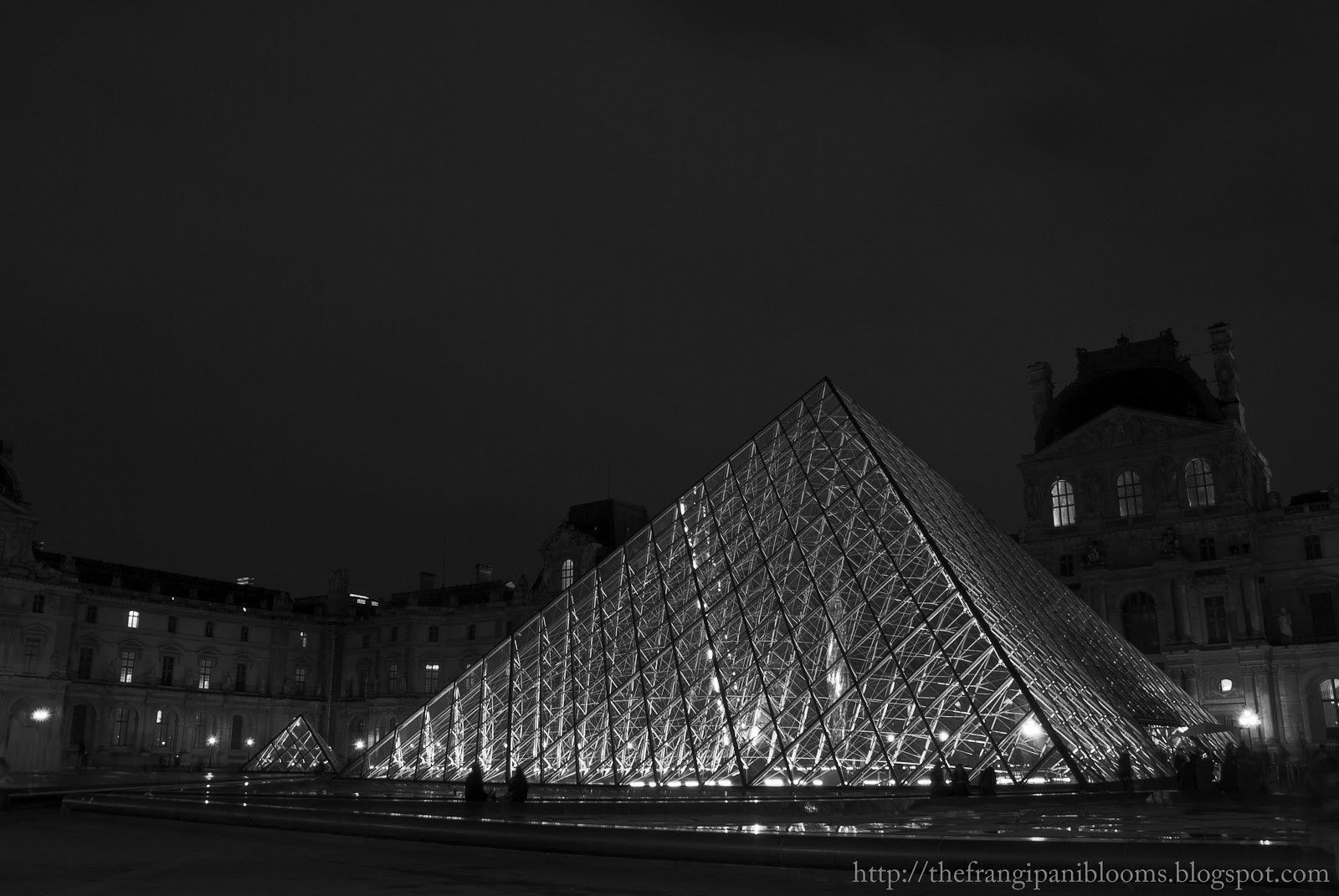
Pyramid at the Louvre
The Louvre
But nothing comes close to the Impressionists’ works that I saw at the Musée D’Orsay the day before. It was a great pity that I could not capture them with my camera. The Impressionists paint light. A summer afternoon under the trees, the afternoon sun on the river, the sunlit fields and woods, the pale winter sunshine on a snowy day, the hedges full of flowers and the sky full of colors, the city streets glistening under the lights of the night: every Impressionist painting that I saw took my heart away. Renoir, Monet, Manet and others have given the world an enduring gift-a bit of sunshine on a canvas.


Autumn Sunshine
Autumn sunshine at the Luxembourg Gardens


_________________________________________________________________________________
3. Café : a restaurant primarily serving coffee as well as pastries and light meals such as sandwiches 

Brasserie: A type of French restaurant with a relaxed, upscale setting, which serves single dishes and other meals. A brasserie can be expected to have professional service, printed menus, and, traditionally, white linen —unlike a bistro which may have none of these. Typically, a brasserie is open every day of the week and serves the same menu all day 


Bistro: a small restaurant serving moderately priced simple meals in a modest setting. Bistros are defined mostly by the foods they serve. French home-style cooking with robust earthy dishes, and slow-cooked foods like cassoulet, a bean stew, are typical 


Crêperie: a takeaway restaurant or stall, serving crêpes as a form of fast food or street food, or may be a more formal sit-down restaurant.


4.Standard and Poors and Moodys have downgraded France's sovereign debt rating from AAA and Aaa to AA+ and Aa1 respectively in 2012 while Fitch has a negative outlook with its AAA rating

Sunday, 27 December 2009

Truly Asia


Its been a little bit of a predicament to discover the real Asia, and that's pretty ironical coming from an Asian. But the truth of the matter is that Asia's simply too vast and too diverse to have one 'true' self. It also true that South East Asia is a much more closely knit region than South Asia. South Asia, due to its adjacency to Persia, the Middle East, and its connections to Europe via the sea was always in a state of diffusion of cultures and peoples. And so there have always been significant differences between India and her eastern neighbours - differences that go way beyond that fold of eyelid skin that gives East Asians their 'oriental' look. And the Orient traditionally meant lands to the east of India.
Malaysia's marketing campaign claims it to be 'Truly Asia', but the capital city of Kuala Lumpur spoke of an Asia very different from the conventional images of a 'mysterious and exotic' Far East. It spoke of a region fast rising on the wings of western capitalism, riding new technology, new business practices and creating its own place under the sun. Nothing could be more emblematic of KL than the twin Petronas towers seen above, taken at a really low shutter speed.


Downtown KL glittered and sparkled after a late downpour, and city looked like a party-goer and shoppers paradise. The conversion rate of the Malay Ringit makes spending in SGD deceptively easy, and that never bodes well for the shopper's purse. KL has all the brands you've ever known about, and probably some that you've not known about. The stores and malls can give any American mall a run for its money, and the downtown is studded with diners and cafes for the hungry and watering holes for party-goers.

Kuala Lumpur is doing all the right things: working towards establishing a good infra-structure, inviting retailers from all over the world to tap into its very receptive markets, and getting it's people hooked on to a diet of malls and showrooms and shopping. Selling itself as the ultimate shopping destination and drawing in hordes of tourists from within the country and abroad, KL is is doing everything it can to whip up a voracious retail appetite in its markets.


It has a casino at the near-by hill resort of Genting. The clown here was one of the many attractions on the way to Genting, trying to make life a little more entertaining for people queueing up for the 20 minute cable car ride up the mountain. And as soon as we reached the top, we were greeted by a blast of chilly mountain air and some freshly brewed Chinese herbal jelly. The dark mahogany decoction was steamed in huge brass vats, so that it congealed to form a jelly, and was served steaming hot. Its hot pungent aroma filled the air, and very soon, we'd downed two cups of the jelly each, with some very sweet honey water to complement the slight bitterness of the blend. The jelly seller lady who served us with much ado about its health benefits, agreed to pose with her vat of jelly.


The Genting Highlands are roughly an hour's drive from KL, followed by a 4km ride on a cable car that takes you to a height of well over 1700 m. In spite of being in steamy Malaysia, Genting enjoys an almost perfect climate with temperatures ranging between 16 and 24 degrees celcius. Plentiful rainfall ensures lush rainforests covering the slopes. This comes the closest to my idea of an ideal climate...I had never imagined I'd ever want to wear a sweater and sip on some hot chocolate at 4.00 in the afternoon anywhere in South East Asia.

But Genting is too busy being the Las Vegas of Malaysia to pay heed to nature's gifts. We saw a colossal resort filled with an indoor and outdoor amusement park, and of course, a casino. The casino was overflowing with gamblers and the amusement parks were overflowing with picnickers and kids. I saw these two little dudes waiting patiently for their balloons outside one of the many rides.


We had a lovely time trying out the rides. And a little less lovely time watching the games of roulette, and wishing we had enough money to just blow it off on a night in the casino. The shoestring budgets that we had planned our trip on had no room for such extravagances. We did cook up a hypothetical fool proof scheme for making some money on the roulette the next time we came back.

The dining was very fine, and inspite of constraints faced by our vegetarians, we sampled some Vietnamese food. The restaurant had some lovely decor.The food of course was very nice too, but to people famished after a day of trudging theme parks and casinos, I wonder if the taste would have made any difference.
Thus ended our very first attempt to discover Asia. Even though what we saw was the very superficial, fast changing, market driven face of Asia, it was nevertheless one facet of this exotic place. Perhaps there are other things to be discovered by going, not on a trip to a Casino resort, but perhaps on a trek to the rainforests of Indonesia, or a trip to the rice fields of the Phillipines or the temples of Angkor. I hope I get a chance to write about these places in this blog.